
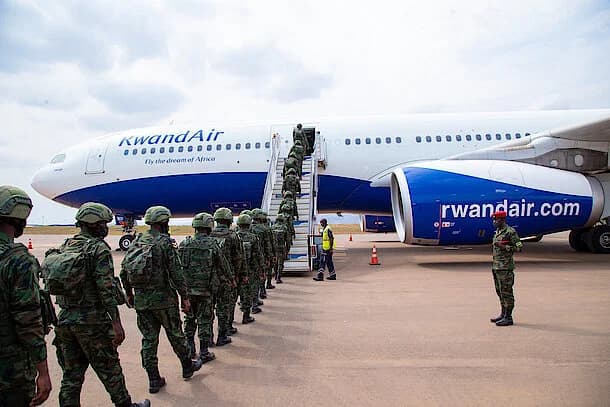
Rwanda has spent at least ten times more on its military deployment in northern Mozambique than it has received in European support funds, government spokesperson Yolande Makolo said on 13 March,2026. Her remarks come as European Union financial support for Rwandan forces operating in Cabo Delgado is set to expire in May 2026, with no plans currently in place to extend the funding. The EU has disbursed approximately €40 million in two tranches, in 2022 and 2024, through the European Peace Facility to support the deployment of the Rwanda Defence Force , mainly covering equipment and logistics.
Rwanda has spent at least ten times more on its military deployment in northern Mozambique than it has received in European support funds, government spokesperson Yolande Makolo said on 13 March,2026.
Her remarks come as European Union financial support for Rwandan forces operating in Cabo Delgado is set to expire in May 2026, with no plans currently in place to extend the funding.
The EU has disbursed approximately €40 million in two tranches, in 2022 and 2024, through the European Peace Facility to support the deployment of the Rwanda Defence Force, mainly covering equipment and logistics.
“The current assistance measures, adopted in 2022 and 2024, expire in May 2026,” an EU spokesperson said, adding that the bloc is assessing the implications of sanctions imposed by the U.S. Department of the Treasury on the RDF.
The sanctions accuse Rwanda's military of directly supporting and fighting alongside the M23 rebel group in eastern Democratic Republic of the Congo, an allegation Rwanda denies.
The security crisis in Cabo Delgado escalated after militants linked to the Islamic State, a designation applied by the United States, carried out a large-scale attack on the town of Palma in late March 2021.
Following the assault, major liquefied natural gas projects, including TotalEnergies' $20 billion development, were suspended, prompting the Government of Mozambique to request military assistance from Rwanda.
Rwanda subsequently deployed troops to Cabo Delgado in July 2021 to help stabilize the region and counter the insurgency.
Makolo said the European support represents only a small fraction of the mission’s overall cost.
“The full cost to the government of Rwanda is at least ten times more, in addition to the ultimate sacrifice of loss of soldiers’ lives,” she wrote in a statement on X.
Rwanda does not publicly disclose casualty figures for its forces deployed in Mozambique.

Rwanda government spokesperson Yolande Makolo. (File photo)
Makolo said Rwanda’s intervention was driven primarily by solidarity with another African country facing a security crisis rather than financial considerations. “Rwandan forces went to Cabo Delgado at the request of the Mozambican government to support a brotherly African country that needed assistance. Money was not the first consideration,” she said. Mozambique’s government did not immediately respond.
Makolo also said the deployment has helped civilians return home and allowed businesses and schools to reopen in previously affected areas, though independent assessments of the mission’s broader security impact remain limited.
She warned that the long-term sustainability of the deployment depends on predictable international support.
“If the Rwanda Defence Force command assesses that the work being done in Cabo Delgado is not appreciated, they would be right to urge the government to end this bilateral counter-terrorism arrangement,” she said.
The European Union did not immediately respond to a request for comment on Makolo’s remarks about potentially ending the deployment.
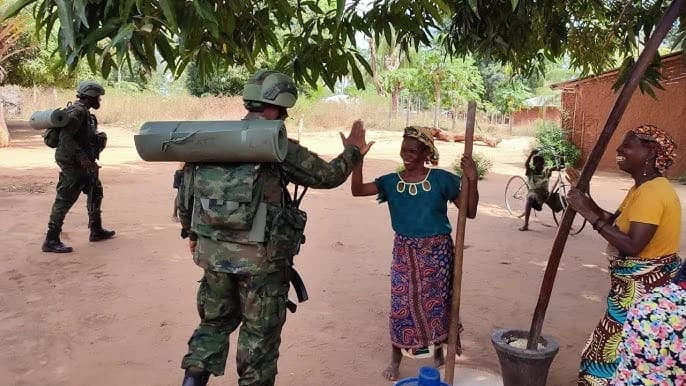
Local Mozambican women greet an RDF patrol in Cabo Delgado (File photo)

Comments
No comments yet. Be the first to share a thought.