
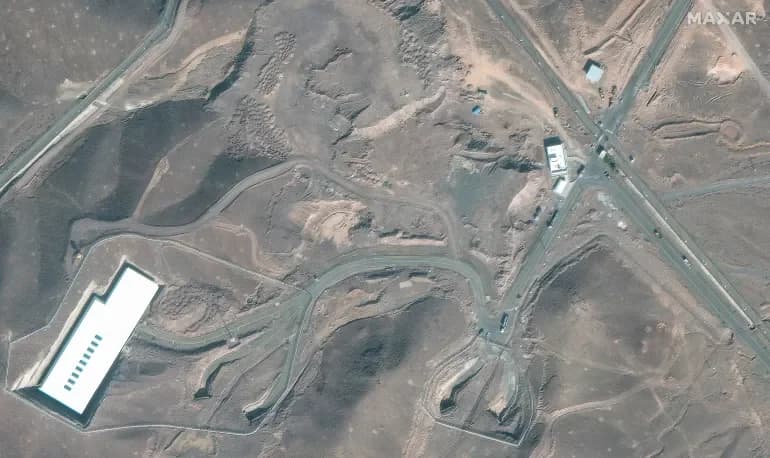
In a move that has escalated already heightened tensions across the Middle East, United States President Donald Trump has confirmed that the US military carried out direct strikes on three major Iranian nuclear sites: Fordow, Natanz, and Isfahan, marking a significant entry of Washington into the ongoing war between Israel and Iran. According to Al Jazeera , on Sunday morning in a televised address, Trump hailed the operation as a “spectacular military success,” asserting that “Iran’s key nuclear enrichment facilities have been completely and totally obliterated.” The announcement came short
In a move that has escalated already heightened tensions across the Middle East, United States President Donald Trump has confirmed that the US military carried out direct strikes on three major Iranian nuclear sites: Fordow, Natanz, and Isfahan, marking a significant entry of Washington into the ongoing war between Israel and Iran. According to
Al Jazeera
, on Sunday morning in a televised address, Trump hailed the operation as a “spectacular military success,” asserting that “Iran’s key nuclear enrichment facilities have been completely and totally obliterated.” The announcement came shortly after Trump had posted a statement on his Truth Social platform, declaring that all US aircraft involved in the operation were safely out of Iranian airspace following the bombings. The strikes were conducted using B-2 stealth bombers and advanced weaponry, including bunker-buster bombs reportedly capable of penetrating fortified underground nuclear facilities. This military intervention represents a dramatic shift in US policy, moving from support for Israel’s military efforts to direct participation. The offensive, which follows Israel’s unprecedented attacks on Iranian targets on June 13, has already drawn severe condemnation and stoked fears of regional war. Over 400 people have reportedly been killed in Iranian territory by Israeli airstrikes, while Iranian retaliatory attacks have resulted in at least 24 deaths in Israel.
Iranian Targeted Destinations
The three targeted facilities: Fordow, Natanz, and Isfahan, have long been central to Iran’s nuclear program.
Fordow, located near Qom, is a heavily fortified underground site known to house nearly 3,000 centrifuges.
Natanz, Iran’s largest enrichment center, which includes both surface-level and subterranean infrastructure and has been the focus of previous sabotage attempts.
Isfahan, plays a key role in converting uranium and fabricating nuclear fuel. Despite repeated accusations from the US and Israel of pursuing nuclear weapons, Tehran has maintained that its nuclear activities are for peaceful, civilian purposes.
What are the US Weapons employed in the Attack?
According to reports in US media, the operation employed the Massive Ordnance Penetrator (MOP), a 13,000-kilogram bomb capable of reaching depths conventional weapons cannot. Each B-2 bomber is designed to carry and sequentially deploy two of these bombs, an approach that reportedly enabled deep penetration into Iran’s fortified nuclear structures. Navy submarines also contributed to the coordinated effort by launching cruise missiles at selected targets.
RECOMMENDED ARTICLE
What is the Response from Iran?
While Trump claimed that the nuclear sites were “obliterated,” the Iranian response offered a more measured account. Iranian officials indicated that the Fordow facility had been evacuated in anticipation of an attack. The Atomic Energy Organization of Iran (AEOI) confirmed the strikes but reported no radiation contamination or immediate threat to nearby civilians. The AEOI insisted that Iran’s nuclear ambitions would not be derailed, emphasizing that the country's nuclear industry is the result of national sacrifice and remains a vital interest. The International Atomic Energy Agency (IAEA) corroborated Iran’s claim that no increase in radiation levels had been detected near the targeted sites. In response to the strikes, the IAEA announced plans to hold an emergency meeting on Monday to assess the situation further.
Diplomatic Fallout
Tehran has responded with outrage. Foreign Minister Abbas Araghchi denounced the attacks as a grave violation of international law and the United Nations Charter. He warned that Iran reserves the right to defend itself and suggested that these strikes might push Tehran to reconsider its commitment to the Nuclear Non-Proliferation Treaty (NPT). Iran’s foreign ministry described the US as engaging in "dangerous war" behavior and accused it of undermining a diplomatic process already in motion. Iran’s Supreme Leader Ayatollah Ali Khamenei had previously warned that US involvement in the conflict would bring “
irreparable consequences
” as reported by Al Jazeera. On Sunday, Araghchi reinforced that stance, saying, “The time for diplomacy has passed.” He accused Washington of enabling Israel’s aggression and making direct war with Iran a reality.
Risks of Escalation
United Nations Secretary-General António Guterres issued a stern warning, calling the attack a “dangerous escalation” and a threat to global peace and security. “There is a growing risk that this conflict could rapidly get out of control, with catastrophic consequences,” Guterres said. Experts emphasized the potentially destabilizing fallout from the strikes. Stephen Zunes, director of Middle Eastern studies at the University of San Francisco, pointed out that the US now faces a significant risk of Iranian retaliation. He noted that with tens of thousands of American personnel and military assets within range of Iran’s missiles and drones, the likelihood of escalation is high. Proxy forces in Iraq could also become active, and critical shipping routes in the Persian Gulf may be endangered, potentially triggering a global energy crisis. Iran has already deployed its advanced Kheibar Shekan missile system against Israel and may further ramp up its military readiness. The possibility of Tehran withdrawing from the NPT looms larger, with Iranian lawmakers suggesting the move is justified under international law in response to what they view as an existential threat. According to Adam Weinstein of the Quincy Institute for Responsible Statecraft, the United States now risks becoming entrenched in a prolonged and potentially unwinnable conflict. “This is how the escalation cycle starts,” he warned. “I’m very skeptical that it will be a one-off strike by the US. I think the US is at risk of being pulled into a war of choice with Iran that, unfortunately, it started.” President Trump, meanwhile, has maintained a confrontational tone. “Any retaliation by Iran against the United States of America will be met with force far greater than what was witnessed tonight,” he wrote on social media following the strikes. As the international community braces for what could become a wider war, the consequences of the US decision to directly enter the battlefield appear far-reaching, not only for Iran and the United States, but for an entire region already on the brink.



Comments
No comments yet. Be the first to share a thought.