
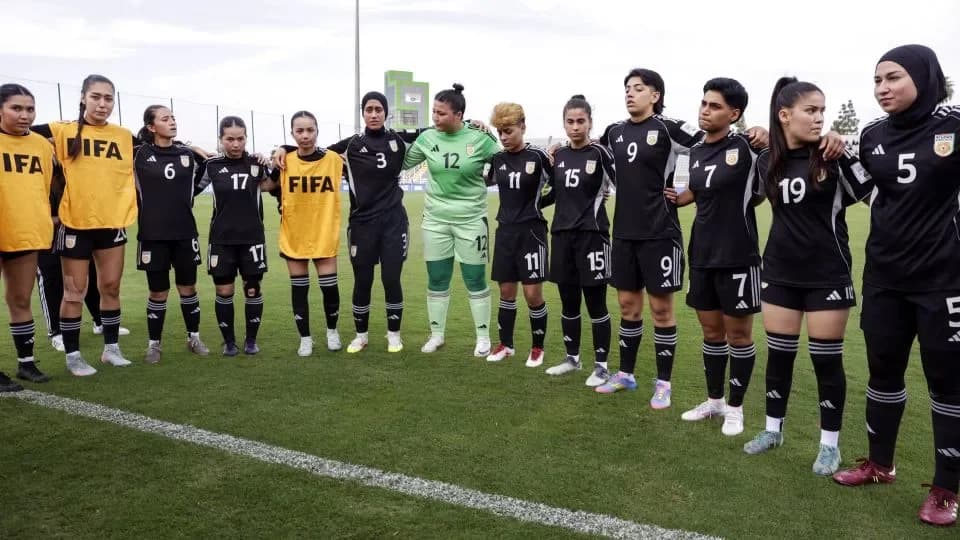
FIFA has passed a landmark ruling allowing Afghan female players to compete as the Afghanistan women's national team in official international matches for the first time, granting full sporting recognition to a squad that has spent nearly five years in exile. The decision, issued at a FIFA Council meeting in Vancouver, British Columbia, rewrites a long-standing rule that required FIFA to recognize a national team through the country's own soccer federation. Afghanistan's federation, operating under Taliban influence since the radical Islamist group returned to power in 2021, had refused to a
FIFA has passed a landmark ruling allowing Afghan female players to compete as the Afghanistan women's national team in official international matches for the first time, granting full sporting recognition to a squad that has spent nearly five years in exile.
The decision, issued at a FIFA Council meeting in Vancouver, British Columbia, rewrites a long-standing rule that required FIFA to recognize a national team through the country's own soccer federation. Afghanistan's federation, operating under Taliban influence since the radical Islamist group returned to power in 2021, had refused to acknowledge the women's program, effectively keeping its female players off the international pitch.
The amendment gives FIFA's council the power to establish or approve a national team registration under exceptional circumstances, specifically to protect players from being excluded from international soccer due to situations beyond their control.
Years in exile
For nearly five years, dozens of Afghanistan's women soccer players have lived in exile, scattered across Australia, the United States and Europe, unable to officially represent their country's national team.
The Afghan women's team played their last competitive match in 2018. Prior to the Taliban's takeover, Afghanistan had 25 women players under contract, most of whom now live in Australia.
Players were forced into hiding, their equipment and medals buried or abandoned, before a coordinated evacuation, led in part by former team captain and activist Khalida Popal, brought dozens of players out of the country.
The squad had been competing under the name Afghan Women United as a FIFA-supported refugee team, a label players publicly rejected. Player Zainab Mozaffari told CNN Sports: "We are tired of getting called refugee." Tuesday's ruling directly addresses that grievance.
Reactions
FIFA President Gianni Infantino said in a statement the initiative aimed to enable Afghan Women United and other member associations in similar situations "to make the next step, in coordination with the relevant confederation."
Khalida Popal said in a statement: "For these players, representing Afghanistan is about identity, dignity and hope. This moment also shows that when we stand united, we can achieve more."
Steve Cockburn, head of economic and social justice at Amnesty International, said the official recognition of the women's team represented a step toward justice for all Afghan women, and proof of what can be achieved when the international community refuses to look away.
Minky Worden, director of global initiatives for Human Rights Watch, said FIFA had finally closed the loophole that allowed the Taliban's discriminatory policies to be enforced on the global stage.
CNN reported that it had reached out to the Taliban-led Afghan government for comment. No response was received at time of publication.
What comes next
The change comes too late for Afghanistan to qualify for the 2027 Women's World Cup in Brazil, but the team could now enter qualifying for the 2028 Olympics in Los Angeles. A training camp is scheduled for the first week of June in New Zealand, where the team will face the Cook Islands. FIFA has committed to providing financial, technical and human support for up to two years through the transition.
The governance amendment also sets a broader precedent that could apply to any national federation that discriminates against its own players in the future.


Comments
No comments yet. Be the first to share a thought.