
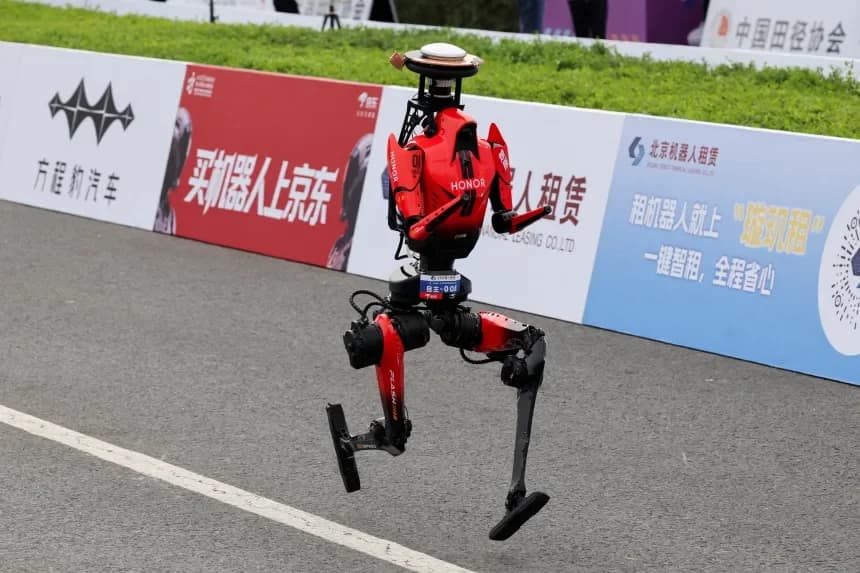
A humanoid robot has won a half-marathon in Beijing, completing the 21-kilometre course in 50 minutes and 26 seconds, a performance faster than the current human world record held by Uganda’s Jacob Kiplimo. The race took place during a dedicated humanoid robotics half-marathon in the Beijing Economic-Technological Development Area, where over 100 teams competed to test robotic endurance, balance, and autonomous navigation over a full road-race distance. The winning robot, named “Flash”, was developed by Shenzhen Honor Smart Technology Development Co., Ltd. and competed under the team Qitiandas
A humanoid robot has won a half-marathon in Beijing, completing the 21-kilometre course in 50 minutes and 26 seconds, a performance faster than the current human world record held by Uganda’s Jacob Kiplimo.
The race took place during a dedicated humanoid robotics half-marathon in the Beijing Economic-Technological Development Area, where over 100 teams competed to test robotic endurance, balance, and autonomous navigation over a full road-race distance.
The winning robot, named “Flash”, was developed by Shenzhen Honor Smart Technology Development Co., Ltd. and competed under the team Qitiandasheng. It completed the race using fully autonomous navigation, without remote control assistance.
Its finishing time of 50:26 is particularly notable compared with Kiplimo’s 57:20 half-marathon world record, set in March 2026 at the Lisbon Half Marathon in Portugal.
The result also highlights the rapid pace of development in the field. Last year’s winning robot completed the same event in approximately 2 hours and 40 minutes, underscoring how significantly performance has improved in just one cycle of the competition.
Organizers noted that the event included multiple categories, including autonomous and remotely controlled robots. A separate robot operated under remote control reportedly crossed the finish line earlier in 48 minutes and 19 seconds, but under race rules its time was adjusted using a penalty coefficient, meaning it did not win the autonomous category.
Officials said the race is designed to test real-world mobility challenges such as endurance, stability, and independent decision-making across a full half-marathon distance.
Flash’s victory marks a significant milestone in humanoid robotics performance under competitive endurance conditions.


Comments
No comments yet. Be the first to share a thought.