
When Paris Saint-Germain edged Bayern Munich 5–4 in a pulsating first leg at the Parc des Princes on April 28, Paul Kagame was in the stands. Seated alongside former French President Nicolas Sarkozy and PSG chairman Nasser Al-Khelaïfi , he was not simply watching football. He was watching a long-term investment play out in real time. For the first time, Rwanda found itself connected, through a network of partnerships, to all four clubs in a Champions League semi-final lineup: Paris Saint-Germain, Arsenal , Bayern Munich, and Atlético de Madrid . It was not a coincidence. It was the result of n
When Paris Saint-Germain edged Bayern Munich 5–4 in a pulsating first leg at the Parc des Princes on April 28, Paul Kagame was in the stands. Seated alongside former French President Nicolas Sarkozy and PSG chairman Nasser Al-Khelaïfi, he was not simply watching football. He was watching a long-term investment play out in real time.
For the first time, Rwanda found itself connected, through a network of partnerships, to all four clubs in a Champions League semi-final lineup: Paris Saint-Germain, Arsenal, Bayern Munich, and Atlético de Madrid. It was not a coincidence. It was the result of nearly a decade of deliberate, incremental brand-building that has turned one of Africa’s smallest nations into a visible presence across European football’s biggest stage.
The Architecture of a Low-Risk Bet
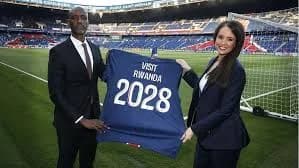
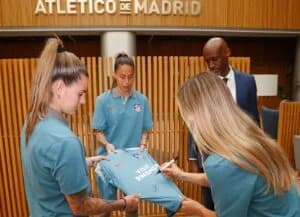
Rwanda’s entry into football sponsorship began in 2018 with a sleeve partnership with Arsenal, a move initially criticised as vanity spending by a developing country. Subsequent agreements with PSG in 2019 and Atlético de Madrid in 2025 expanded its reach across France and Spain, while its partnership with Bayern Munich has focused on youth development through the FC Bayern Academy in Kigali.
The strategic logic is straightforward but rarely executed with such consistency: by aligning with multiple elite clubs, Rwanda reduces the risk tied to any single team’s performance. Progress in the competition translates into extended visibility. Setbacks do not erase it. The deeper these teams advance, the more frequently Rwanda’s branding enters the global broadcast frame.
What Each Partnership Delivers
Each club contributes differently to Rwanda’s broader visibility strategy.
PSG connects Rwanda to French-speaking markets and a global fanbase that spans Europe, Asia, and the Middle East. High-profile Champions League fixtures provide repeated exposure through pitchside branding and broadcast coverage.
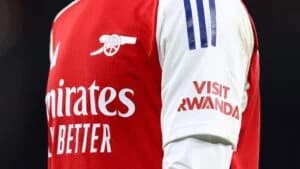
Arsenal represents the longest-standing partnership, anchoring Rwanda’s presence in the English Premier League and across English-speaking audiences worldwide. Over time, the “Visit Rwanda” brand has become a familiar element of matchday broadcasts.
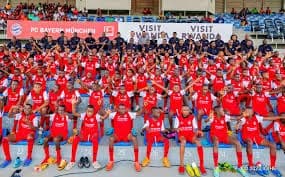
Bayern Munich offers a different form of engagement. While no longer a primary commercial branding platform, its academy project in Kigali provides grassroots development and local visibility, extending the partnership beyond advertising into football infrastructure.
Atlético de Madrid, the newest addition, opens access to Spanish-speaking audiences across Europe and Latin America, expanding Rwanda’s reach into markets it had not previously targeted through football.
For Rwanda’s tourism strategy, this matters: Spanish-speaking markets represent a large and growing pool of outbound travelers, and visibility in both domestic and European competitions positions the country within a new linguistic and cultural space that extends well beyond Europe.
The Numbers Behind the Strategy
Rwanda’s tourism revenue reached $685 million in 2025, up from $647 million in 2024, according to the Rwanda Development Board. Officials attribute part of this growth to increased international visibility driven by sports partnerships, particularly in key European markets such as Germany, France, and the United Kingdom.
The UEFA Champions League remains one of the most-watched sporting competitions in the world. Semi-final matches can draw audiences in the range of 100 to 200 million viewers, according to broadcast and media analytics firms such as Nielsen and industry reports cited by SportsPro.
Across two legs and multiple markets, cumulative exposure reaches into the high hundreds of millions of impressions, offering a level of visibility that would be significantly more expensive to replicate through conventional advertising.
Soft Power Beyond the Scoreline
The value of these partnerships extends beyond tourism metrics. Over the past three decades, Rwanda has worked to reposition its global image, shifting from a country internationally associated with the 1994 Genocide against the Tutsi to one increasingly defined by stability, development, and international engagement.
In this respect, Rwanda’s approach reflects a strategy more commonly associated with wealthier states. Countries such as Qatar and the United Arab Emirates have long used sport as a platform for global visibility and influence.
Rwanda’s model, however, operates on a more focused scale. Without the financial resources of energy-rich nations, it prioritizes targeted, high-impact partnerships over broad, competition-wide investment, using visibility in elite competitions to amplify its presence internationally.
President Kagame’s attendance at the semi-finals, first in Paris and then in Madrid, underscored the diplomatic dimension of the strategy. Heads of state rarely attend football matches simply as spectators. Their presence signals alignment with global platforms of prestige and influence.
The Unlosable Final
When the Champions League final takes place, two of Rwanda’s partner clubs will be involved. The “Visit Rwanda” brand will appear within the broadcast environment, reaching audiences across continents.
The 5–4 scoreline in Paris delivered drama for fans, but Rwanda’s visibility came in quieter, repeated moments, each time its branding appeared pitchside. The same held true in Madrid, where the exposure continued under the lights of another high-stakes European night.
Whatever the result on the pitch, the visibility itself is assured. It reflects a broader strategy that uses football not only as entertainment, but as a platform for sustained international presence.
Beyond the spectacle of the game, there is a deliberate calculation at work, one that turns visibility into influence. In that sense, Rwanda is not simply participating. It is playing a different game entirely.
Comments
No comments yet. Be the first to share a thought.